


Table of Contents
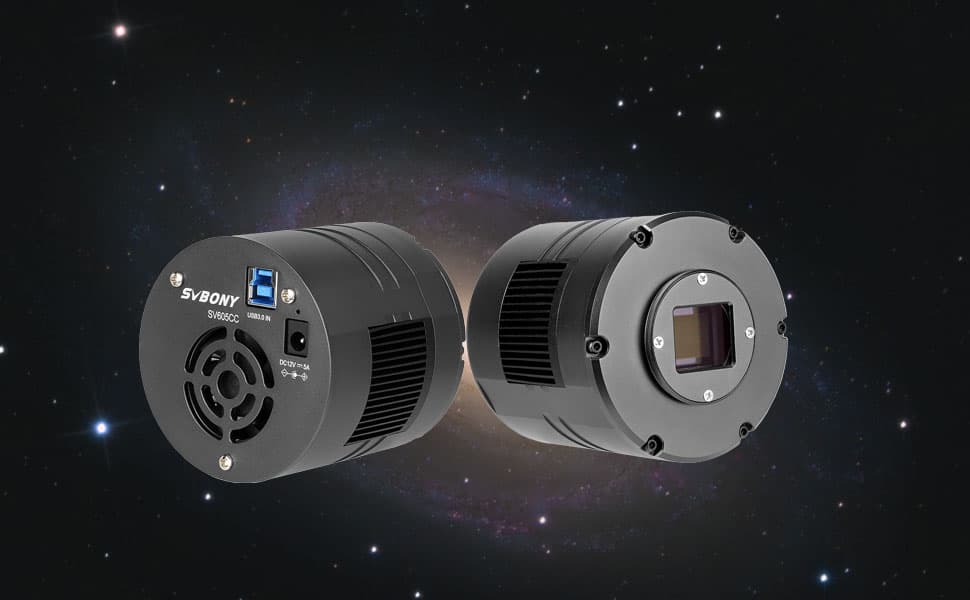
SV605CC Cooled Camera Full Reviews
Photoelectric combination products increase the playability of cold optical products, and also extend visual observation to planetary photography and deep space photography, revealing the mysterious veil of the universe. Satisfy the curiosity of fans. The deep space camera is a product used by senior amateur customers in astronomical photography and one of the necessary items for enthusiasts.
Deep space shooting targets are mainly nebulae, galaxies, star clusters, multi stars, etc. (Please refer to Messier object) The main feature of shooting deep space objects requires a long exposure time of the camera, which may take 1 hour or 2 hours to take a dim and distant picture of deep space nebula. The camera is characterized by its cooling/cooling function.
Deep space cameras also include color cameras and mono cameras. The color camera is mainly suitable for entry-level use, and experienced customers will also use the color camera with double narrowband filters for photography; Generally, high-level enthusiasts use monochrome cameras with LRGB filters or SHO narrowband filters to complete the shooting. Later, they use software to stack, stack, and turn colors to get a gorgeous sky map.
What is the SV605C Cooled Camera?
SV605CC is a 1-inch color deep space camera with 3.76um pixel size and better resolution, which basically achieves the balance of pixel size. No glow, very low dark current. 80%+quantum efficiency, combined with double narrowband filters, can get good imaging in light polluted environment.
The Characteristics of SV605CC?
- Back-illuminated sensor - improving sensitivity and reducing noise.
- 1'' format with 3.76 um pixel size - ideal for many types of telescopes.
- 14-bit ADC - giving high dynamic range of 13 stops.
- An impressive 50ke-full well capacity - helping to reduce the issue of,for example,saturated stars.
- HCG mode - When set the gain at 120 or higher,the HCG mode is autonatically enabled,and reduce the read noise to even lover levels without loss the dynamic range.
- Two-stage TEC cooling - Thanks to the two-stage TEC cooling, the SV605CC can lower the CMOS sensor temperature to 30 degrees Celsius below ambient temperature, which can greatly reduce dark current generation and sensor noise even during longer exposure times.
- 256M DDR3 Cache - The SV605CC has a built-in 256MB DDRIII image buffer. The benefit of the image buffer is that the memory will cache the image and transfer it to the computer when the USB interface is not busy or being interrupted, so that the frame won't be lost or corrupted. This buffer also allows a slower computer with USB 3.0 to capture every frame without loss even if the USB bus is occasionally busy with other peripherals. This buffer also makes it possible to run another camera using the same computer without USB transfer problems from the SV605CC.
Equipment Connection
55mm back intercept
Flattener+3x adapter+SV605CC
(16.5mm+21mm+11mm+6.5mm=55mm)
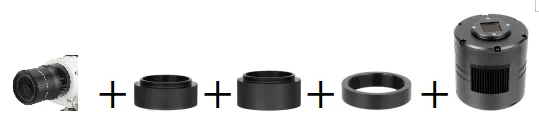
Connected to 1.25 and 2-inch telescopes
SV605CC+T2 adapter+T2 to 1.25 "adapter+1.25" OTA
SV605CC+T2 adapter+M48F+M42M+16.5 adapter+2''OTA

Equipped with a telescope connected to M42/M48 threaded interface
Connected to 1.25 and 2-inch telescopes
SV605CC+T2 adapter+M42M+M42F+21 adapter+M42 thread OTA
SV605CC+T2 adapter+M42M+M48F+16.5 adapter+M48 thread OTA
Application Scenarios of SV605C Camera
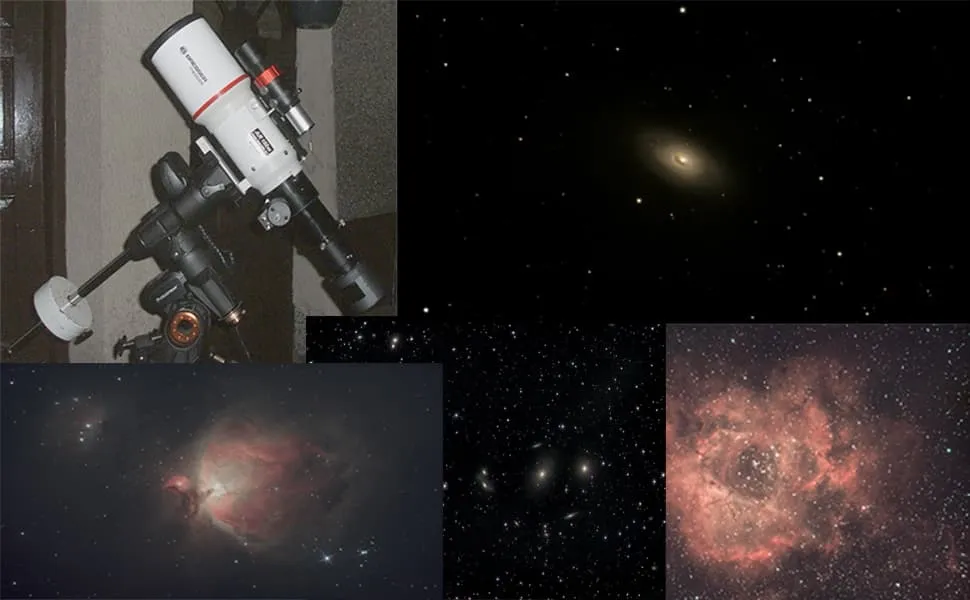
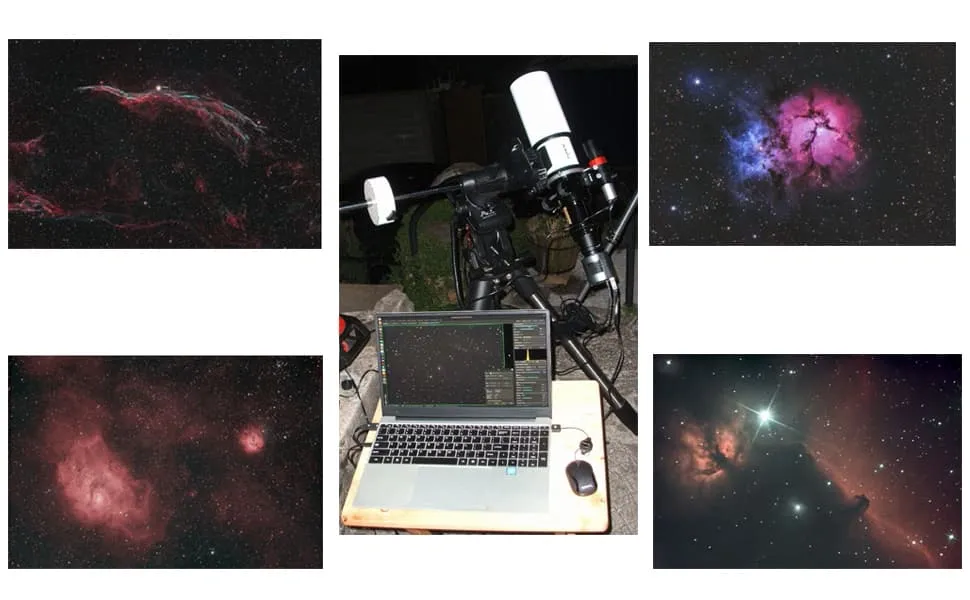
Nebula, Cluster, Star chain and Galaxy
Solar/Lunar
The following is the process by which Dr. Steve Wainwright uses the SV605CC OSC CMOS camera for lunar imaging.
Equipment Configuration
This lunar imaging session utilized the following equipment setup:
- SV605CC OSC CMOS camera (fitted with a UV/IR cut filter)
- Skymax 127 Maksutov–Cassegrain telescope
- Celestron AVX GOTO mount
- AstroDMx Capture for Linux imaging software
Imaging System Setup
The imaging system ran on a Lenovo Thinkpad X270 laptop with Linux Mint as the operating system. In addition to AstroDMx Capture software, an INDI server was also running to control the Celestron AVX GOTO mount on which the telescope was mounted.
Guide Scope Calibration
To better align the guide scope with the main telescope, a second instance of AstroDMx Capture was run on another virtual desktop of the imaging computer. This instance was connected to an SV305 camera mounted on an F=190mm, 50mm guide scope, serving as the guide camera.
By adjusting the ring screws on the guide scope, the Moon was positioned within the guide scope's field of view. While co-aligning the guide scope with the imaging scope is not generally considered necessary, it can be beneficial when using a long-focal-length imaging telescope. Additionally, we plan to conduct plate-solving experiments using the guide system.
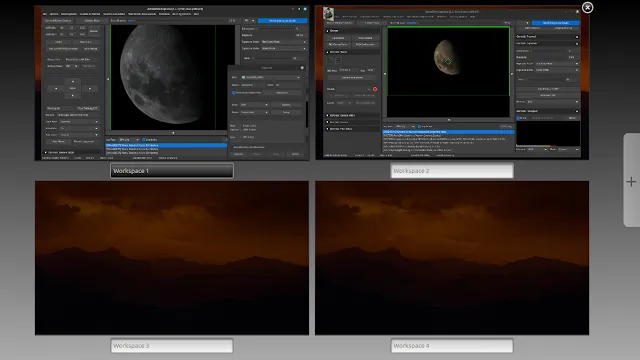
Screenshot showing all 4 virtual desktops of the Linux Mint computer with the main imaging camera in AstroDMx Capture in the top left desktop and the guide camera in the second instance of AstroDMx Capture in the top right desktop.
Image Acquisition and Processing Workflow
1. Image Acquisition
Two overlapping 1000-frame SER video files of the Moon were captured using AstroDMx Capture.
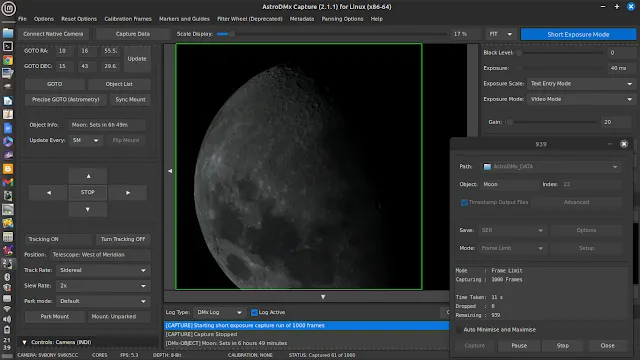 2. Frame Stacking
The best 900 frames from each SER file were stacked using Autostakkert running in a Wine environment.
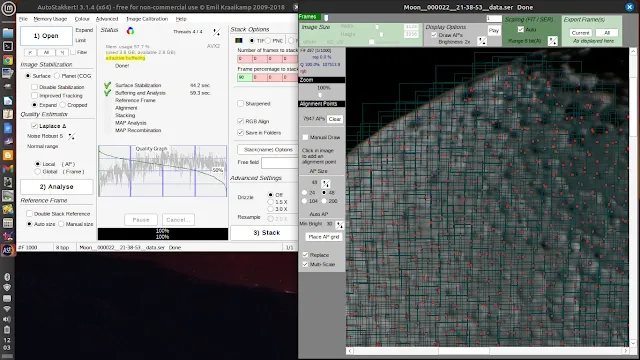 3. Image Mosaic Assembly
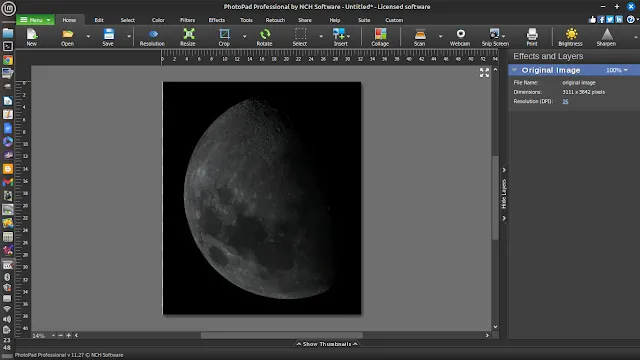
The two stacked images were combined into a complete lunar mosaic using Photopad Image Editor running in Wine.
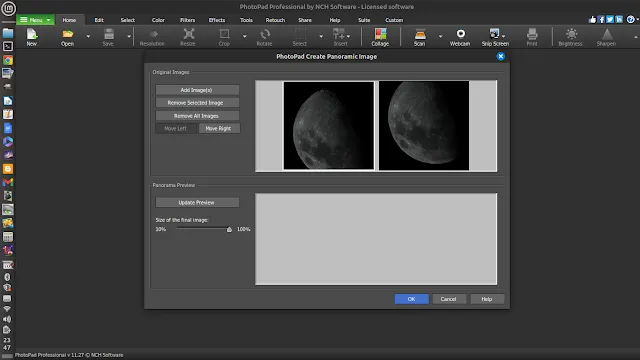
 4. Sharpening Process
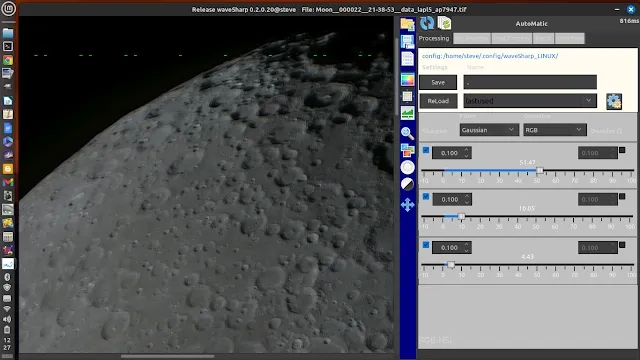
The resulting mosaic was wavelet-processed using waveSharp, a cross-platform program developed by Cor Berevoets (creator of Registax) and a small team of programmers.
 5. Post-Processing
The sharpened image was further refined using GIMP 2.10.
Imaging Result
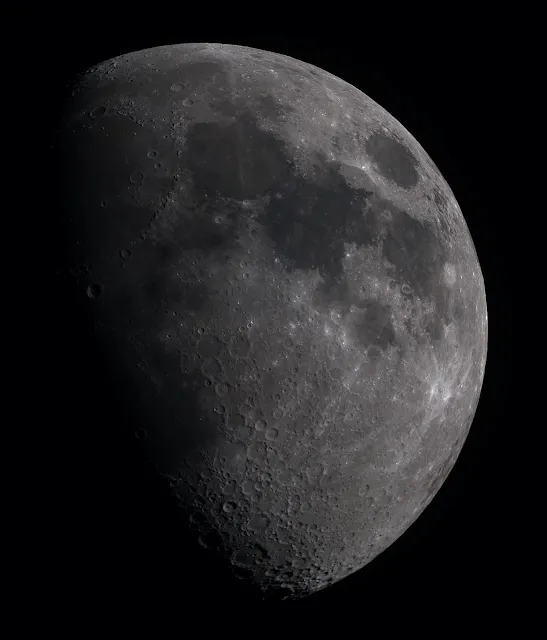
A high-quality image of the 68.6% waxing gibbous Moon was obtained.
SV605CC Tests NINA & Sharpcap Sensor Analysis - Fran Ruiz
Since I only see clouds and more clouds after receiving the SV605CC I kept myself busy doing some camera tests.
So far so good, I was able to connect it to NINA using the latest drivers (both native and ASCOM) and use the cooling, which performed quite nicely. I set it to 0º from 28º which raised the power up to 85%. Once it achieved 0º the power lowered to 70%, and the temperature was very stable for my 30min test.
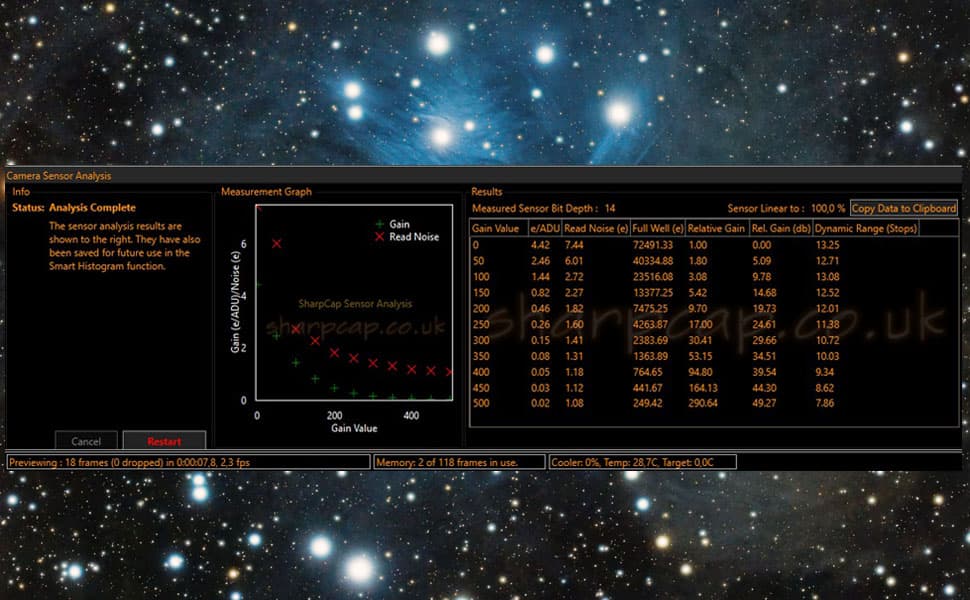
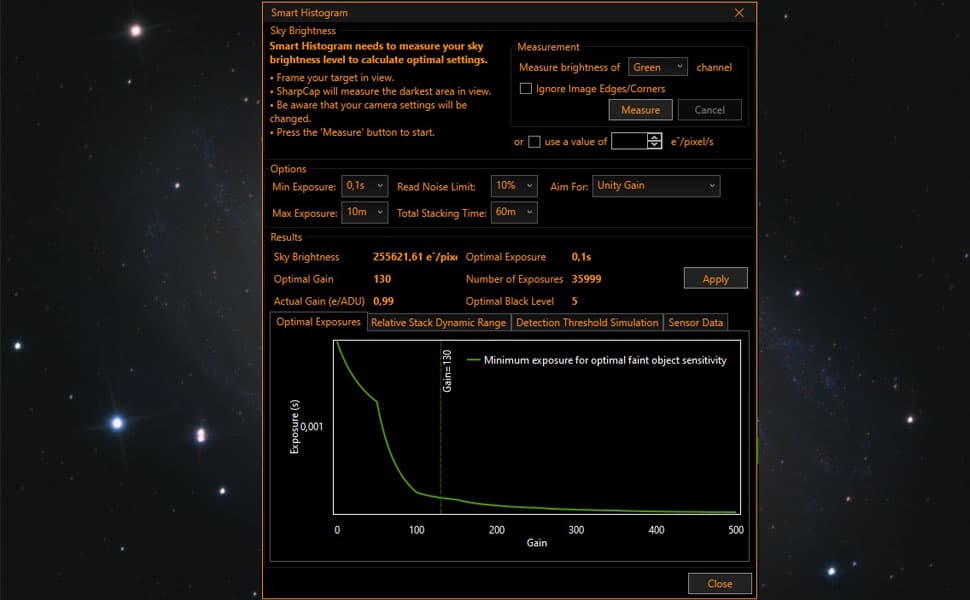
I have also done a sensor analysis with Sharpcap and I got some nice results:
Full well capacity = ~73000, this is interesting as ZWO variant report only up to 50k and QHY up to 58k. I've read Player One raised it to 73k also for their Saturn-C model based on the same chip. This is an awesome improvement compared to other brands. Did Svbony do something to raise the theoretical limit?
Unity Gain = 130, seems much higher than ZWO variant which reaches unity gain at 100 and QHY at 68. Again Player One variant is close with unity gain at 125. I wonder why unity gain is so different from one brand to another, is that because of the AD converter which I guess is unique for each brand?
Has anyone else test their unit yet? I'm looking forward to see if you have obtained similar results.
Good day all!
Welcome to comment.
 Google
 Amazon
There are no customer reviews yet . Leave a Reply !